Capturing Flavour - How ASKAFOODTECH Teams Up with Foodie Shots for Compelling Packaging

Stewart Eddie • February 18, 2025

At ASKAFOODTECH, we know that effective product representation goes beyond quality ingredients and cutting-edge packaging—it’s about connecting with consumers at first glance.


In today’s market, visuals are pivotal, particularly in the food industry where first impressions are crucial. That’s why ASKAFOODTECH collaborates with Foodie Shots, led by the magician of the lens, Kat Lynn.


Kat’s energy is only matched by her creative genius. She brings a keen eye and years of experience in professional food photography, ensuring our clients’ products are showcased with precision and creativity.

Why FoodieShots?

ASKAFOODTECH knows the value of having skilled professionals in our business network. Not only that, we entrust Foodie Shots, to take high quality images for our photo library for use in social media, our website or print media. We’ve seen Kat weave her creative spell over products live at the 2024 Naturally Good Expo. What Kat can achieve in 15 minutes with a few simple props is mind blowing, let alone the masterwork she does for her clients on a daily basis. Kat’s expertise in food styling and professional photography is invaluable for brands aiming to elevate their visual presence.


Kat understands food—from the science behind texture and colour to the art of capturing the perfect image. Kat

consistently delivers imagery that reflects our clients’ branding, meets regulatory compliance, and enhances consumer appeal.

Showcasing Food Products with Professional Precision

When we engage Foodie Shots, it’s more than a simple photo session. We discuss every detail with Kat, from lighting to styling, whether it’s a vibrant colour or unique texture—are highlighted to perfection. Kat shares our commitment to food safety and quality, understanding that these values translate visually as much as they do in the ingredient list.

Bridging Science and Creativity

ASKAFOODTECH brings the technical expertise, while Kat adds the creative flair.

Ready for your product to Stand Out on the Shelf?


If you’re ready to make a lasting impact, ASKAFOODTECH and Foodie Shots, can help get you there. Together we can take your product from the lab to the lens—enhancing its appeal and connecting it with consumers on an instinctual level.


With ASKAFOODTECH and Kat Lynn’s creative expertise at Foodie Shots, it’s not just about capturing an image; it’s about capturing a vision.


Stewart Eddie

About the Author:

Stewart Eddie (Bapp Sc Food Science & Technology) is Director and Principal Food Tech at ASKAFOODTECH PTY LTD; a food technology consulting company that inspires, educates, and serves food producers with an ambition to grow and manage risk. Living with a severe food allergy and being a food technologist, Stewart is uniquely placed to help your food manufacturing business with your allergen management planning. If you would like more information on the services that ASKAFOODTECH PTY LTD can provide, please contact us.

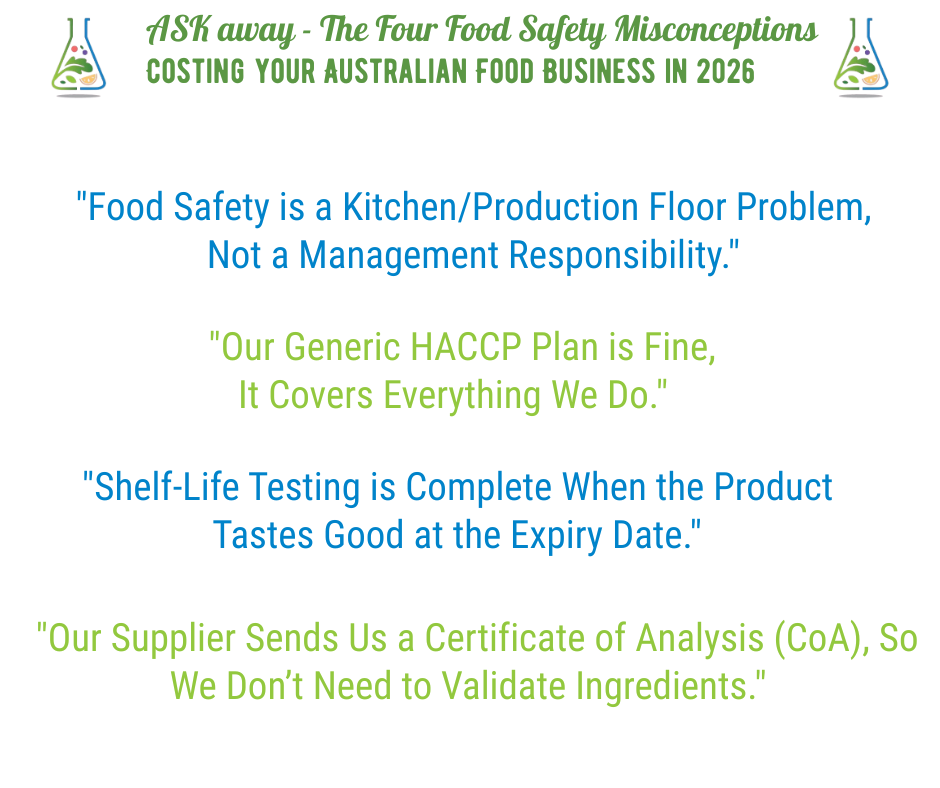
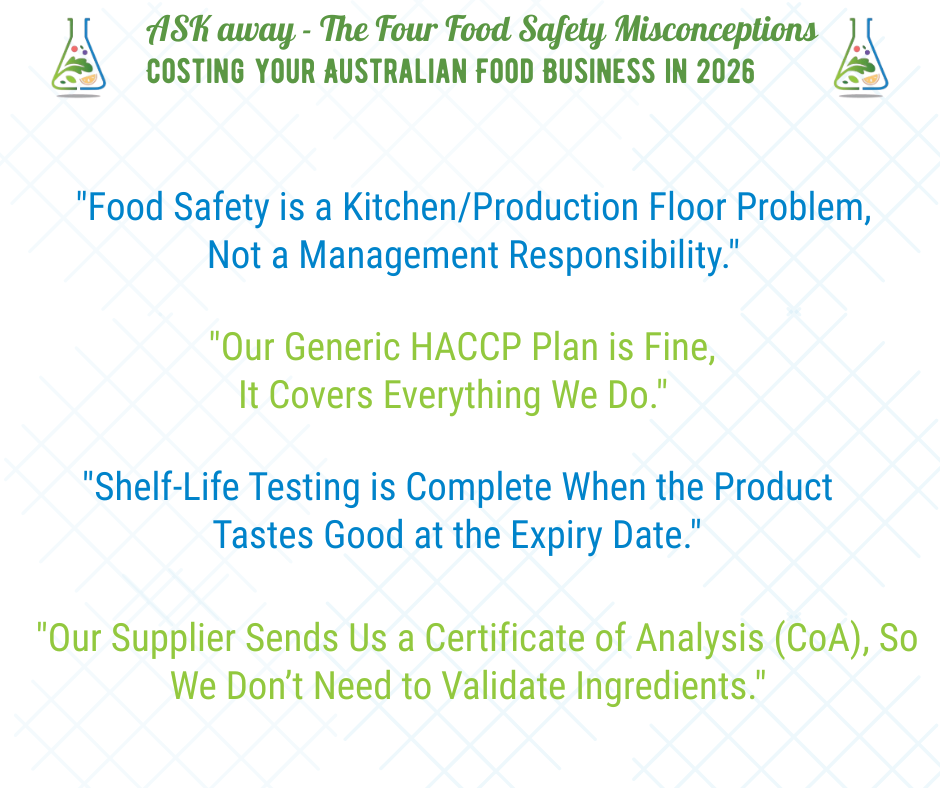
Four food safety misconceptions costing Australian food businesses in 2026, listed as quotes.
March 6, 2026
Food safety isn’t just about avoiding a fine; it’s the non-negotiable foundation of your brand’s trust, reputation, and long-term viability. As an Australian food producer, adhering to the Safe Food Australia standards (regulated by FSANZ) is mandatory, but compliance can often be clouded by common misunderstandings. In honour of Food Safety Month, ASKAFOODTECH is breaking down the top four dangerous misconceptions we see in the industry and revealing the true ramifications of non-adherence. Top 4 Misconceptions and Their Ramifications: "Food Safety is a Kitchen/Production Floor Problem, Not a Management Responsibility." Many businesses delegate food safety solely to production staff or quality control teams, viewing it as a checklist rather than a core business strategy. Ramifications of Non-Adherence (Lack of Leadership): Inadequate Resources & Training: When management isn't bought in, budget for proper training, modern equipment, and robust record-keeping systems often falls short. This leads to systemic failure points that Q.C. alone cannot fix. Failed Culture of Safety: Food safety must be driven from the top down. A weak safety culture increases the risk of critical errors, resulting in serious regulatory breaches, major product recalls, and even premises closure by state/territory food authorities. "Our Generic HACCP Plan is Fine—It Covers Everything We Do." HACCP (Hazard Analysis and Critical Control Points) is the backbone of safe food production, but a one-size-fits-all, off-the-shelf document is often insufficient for a complex, evolving operation. Ramifications of Non-Adherence (Generic Plans): Invisible Risks: Generic plans fail to account for the specific hazards of your unique equipment, new product formulations, process steps, or facility layout. This leaves significant and unmanaged risks in your critical control points (CCPs). Legal Vulnerability: In the event of a foodborne illness outbreak, regulators will audit your documentation. If your plan is generic and doesn't accurately reflect your actual process or the hazards encountered, your business may be deemed negligent, leading to severe fines and immediate public health orders. "Shelf-Life Testing is Complete When the Product Tastes Good at the Expiry Date." Sensory evaluation (taste, texture, smell) is only one part of shelf-life assessment. True compliance requires microbiological and chemical stability testing to prove the product is safe and compliant for the entirety of its life. Ramifications of Non-Adherence (Incomplete Shelf-Life Data): Unsafe Product in Market: A product can look and taste fine but still contain dangerous levels of pathogens (like Listeria or Salmonella) or toxins. Releasing a product with unproven safety is the fastest route to mass consumer illness and prosecution. Loss of Retail Trust: Major retailers demand robust, defensible shelf-life data. Without it, you lose credibility, cannot secure premium placement, and risk costly de-listing should a safety incident occur. "Our Supplier Sends Us a Certificate of Analysis (CoA), So We Don’t Need to Validate Ingredients." A CoA is important, but a due diligence defence under the FSANZ standard requires more than just receiving a piece of paper. Your business is ultimately responsible for the safety of its final product. Ramifications of Non-Adherence (Blind Trust): Allergen Cross-Contamination: Relying solely on a supplier's CoA for allergens without establishing clear receiving protocols, verification checks, or having an appropriate supplier approval program exposes your customers to undeclared allergens—the most common cause of Australian product recalls. Contaminant Risk: If a supplier's raw material fails to meet safety limits (e.g., heavy metals, pesticides) and you haven't validated their control measures, you are responsible for the contaminated product on Australian shelves.
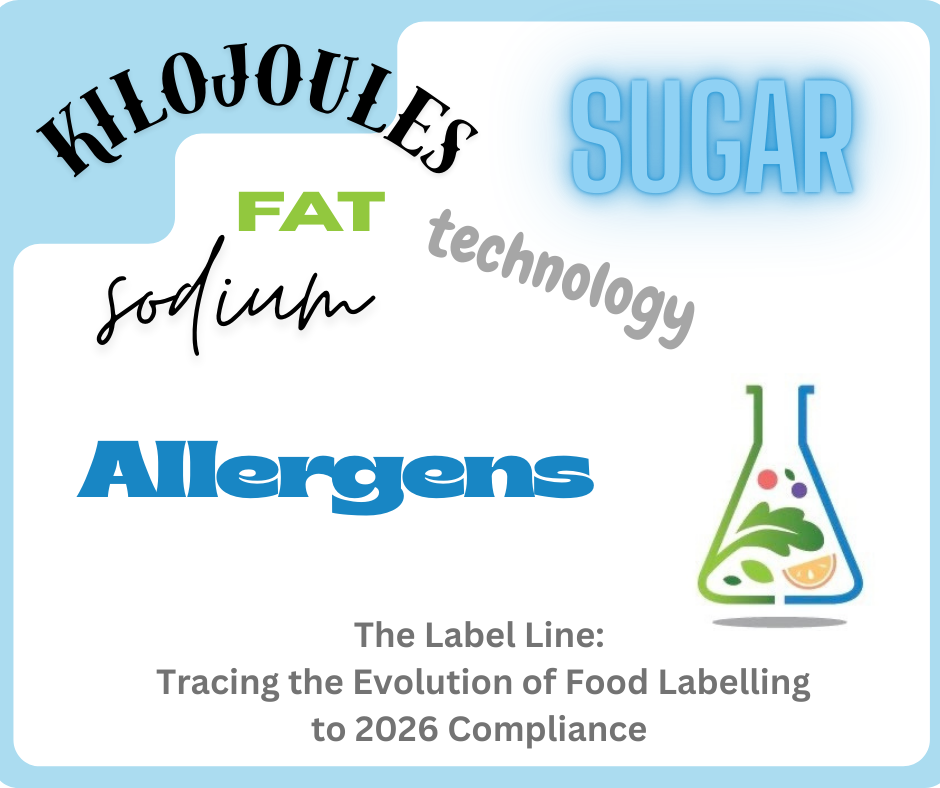
Food label graphic with keywords
February 26, 2026
Food labelling has come a long way since the days of simple ingredient lists. What was once a basic legal requirement has evolved into a dynamic, complex, and vital tool for consumer safety, public health, and brand trust. For Australian food producers, understanding this evolution isn’t just interesting—it’s critical for compliance in 2026. At ASKAFOODTECH , we’ve spent decades guiding businesses through this shifting landscape. This Food Labelling Month, we’re looking at how the industry has changed and what you need to focus on right now, from Simple Lists to Scientific Mandates. The history of food labelling is a story of increasing transparency, driven by public demand and medical necessity. Early regulations focused primarily on preventing fraud - ensuring a product was what it claimed to be. The first major evolution began in the late 20th and early 21st century with the global rise in food allergies. Suddenly, an ingredient list wasn't just about what was in the food; it was about what must not be in the food for certain consumers. This shift mandated clearer, specific allergen declarations, moving from an implied duty to an explicit, bolded safety requirement. The introduction of the mandatory Nutrition Information Panel (NIP) marked the next giant leap. What was once optional became a requirement for public health. This empowered consumers to track kilojoules, fat, sugar, and sodium, transforming the label into a crucial dietary decision-making tool. The Pillars of Modern Compliance (2026) Today, compliance is no longer a static, once-off task. It’s a dynamic process influenced by technology, consumer scrutiny, and continually updated Food Standards Codes. In 2026, compliance rests on three key pillars:
February 18, 2026
The "Back to Work" rush of January 2026 feels fundamentally different for the Australian food industry. While the start of the year is usually a time for blue-sky dreaming and bold new concepts, this year, the focus is grounded in a high-stakes reality: Precision and Accountability. As we move into Q1, the winners in the market will be those who successfully balance AI-driven innovation with absolute regulatory integrity. At ASKAFOODTECH, we’re seeing four critical pillars that every food business must navigate to ensure their 2026 is defined by growth, not litigation. 1. The PEAL Final Deadline: February 25, 2026 If you have older stock sitting in a warehouse or on a retail shelf, the clock isn’t just ticking, it’s about to strike midnight. February 25, 2026 , marks the absolute end of the two-year "stock-in-trade" period for Plain English Allergen Labelling (PEAL). After this date, the transition is over. Every single product sold in Australia must strictly adhere to the new bolding and naming conventions. We are currently helping clients identify "hidden traps" in their inventory, such as: Terminology Errors: Ensuring "soy" is used instead of "lecithin" and specific tree nuts (like "almond" or "cashew") are named individually. Formatting Fails: Confirming the Contains summary statement is in the same field of view and bolded correctly. The Risk: After February 25, non-compliant stock is a target for mandatory recalls and consumer protection action. Now is the time for a final label audit.
Cinnamon sticks tied with ribbon, surrounded by star anise, pine needles, and pine cones.
By Stewart Eddie December 22, 2025
Discover the food science behind festive flavours like cinnamon, gingerbread and peppermint, and learn how Australian brands can develop winning Christmas products.
Brown Paper Bag with Ask a Food Tech Logo
By Stewart Eddie November 27, 2025
Food safety isn’t just about expiry dates. Learn how formulation, processing, packaging and real-world storage conditions protect your brand and your consumers.
Cleaning hands vs sanitising hands
By Stewart Eddie July 22, 2025
For any food business, ensuring the safety of your products is paramount. It’s not just about compliance; it’s about protecting your customers, safeguarding your brand, and building trust. And at the heart of this protection lies a critical distinction that often gets blurred: the difference between cleaning and sanitising. At ASKAFOODTECH, we frequently encounter confusion around these terms. Many believe they're interchangeable, but they serve distinct purposes in your food safety regimen. Understanding and correctly applying both is non-negotiable for a hygienic and compliant operation. What is Cleaning? Think of cleaning as the first, essential step. It’s about removing visible dirt, food residues, grease, and other debris from a surface. This process typically involves: Physical action: Scrubbing, wiping, brushing. Detergents: Soaps or chemical cleaners designed to break down fats and loosen soil. Water: To rinse away the loosened dirt and cleaning solution. Why is cleaning crucial? Because you can't effectively sanitise a dirty surface. Organic matter (like food scraps) can protect microorganisms from sanitiser, rendering the sanitising step ineffective. As Food Standards Australia New Zealand (FSANZ) states, "Surfaces must be cleaned before they are sanitised" (Food Standards Australia New Zealand, n.d., p. 116).
More Posts