
The Four Food Safety Misconceptions Costing Your Australian Food Business in 2026
Food safety isn’t just about avoiding a fine; it’s the non-negotiable foundation of your brand’s trust, reputation, and long-term viability. As an Australian food producer, adhering to the Safe Food Australia standards (regulated by FSANZ) is mandatory, but compliance can often be clouded by common misunderstandings.
In honour of Food Safety Month, ASKAFOODTECH is breaking down the top four dangerous misconceptions we see in the industry and revealing the true ramifications of non-adherence.
Top 4 Misconceptions and Their Ramifications:
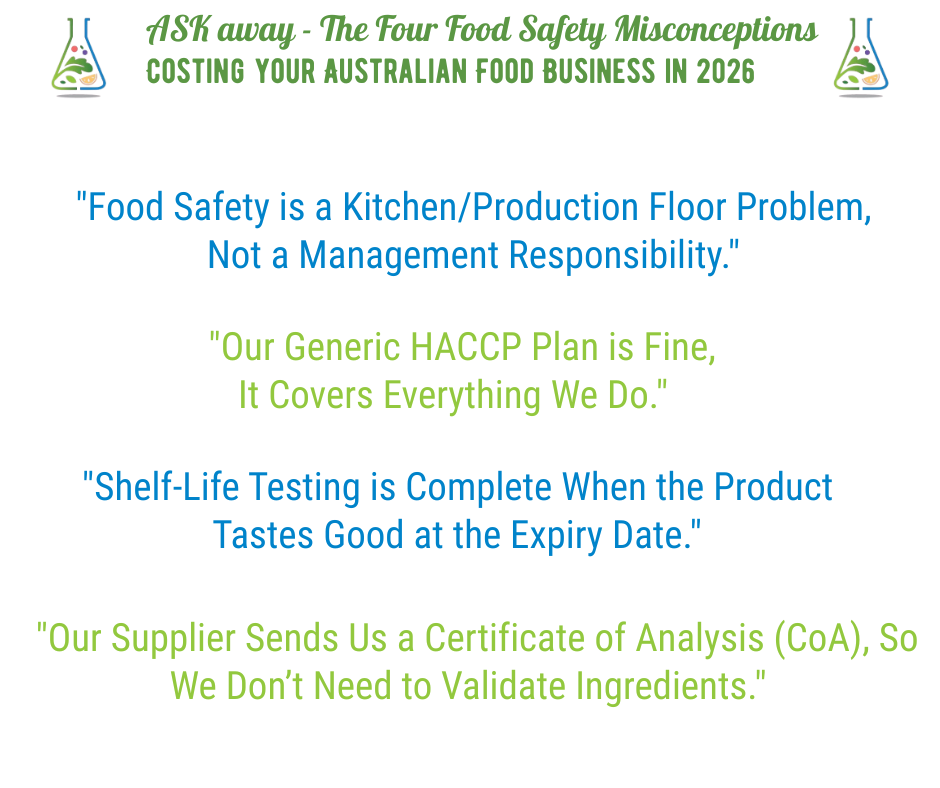
"Food Safety is a Kitchen/Production Floor Problem, Not a Management Responsibility."
Many businesses delegate food safety solely to production staff or quality control teams, viewing it as a checklist rather than a core business strategy.
Ramifications of Non-Adherence (Lack of Leadership):
- Inadequate Resources & Training: When management isn't bought in, budget for proper training, modern equipment, and robust record-keeping systems often falls short. This leads to systemic failure points that Q.C. alone cannot fix.
- Failed Culture of Safety: Food safety must be driven from the top down. A weak safety culture increases the risk of critical errors, resulting in serious regulatory breaches, major product recalls, and even premises closure by state/territory food authorities.
"Our Generic HACCP Plan is Fine—It Covers Everything We Do."
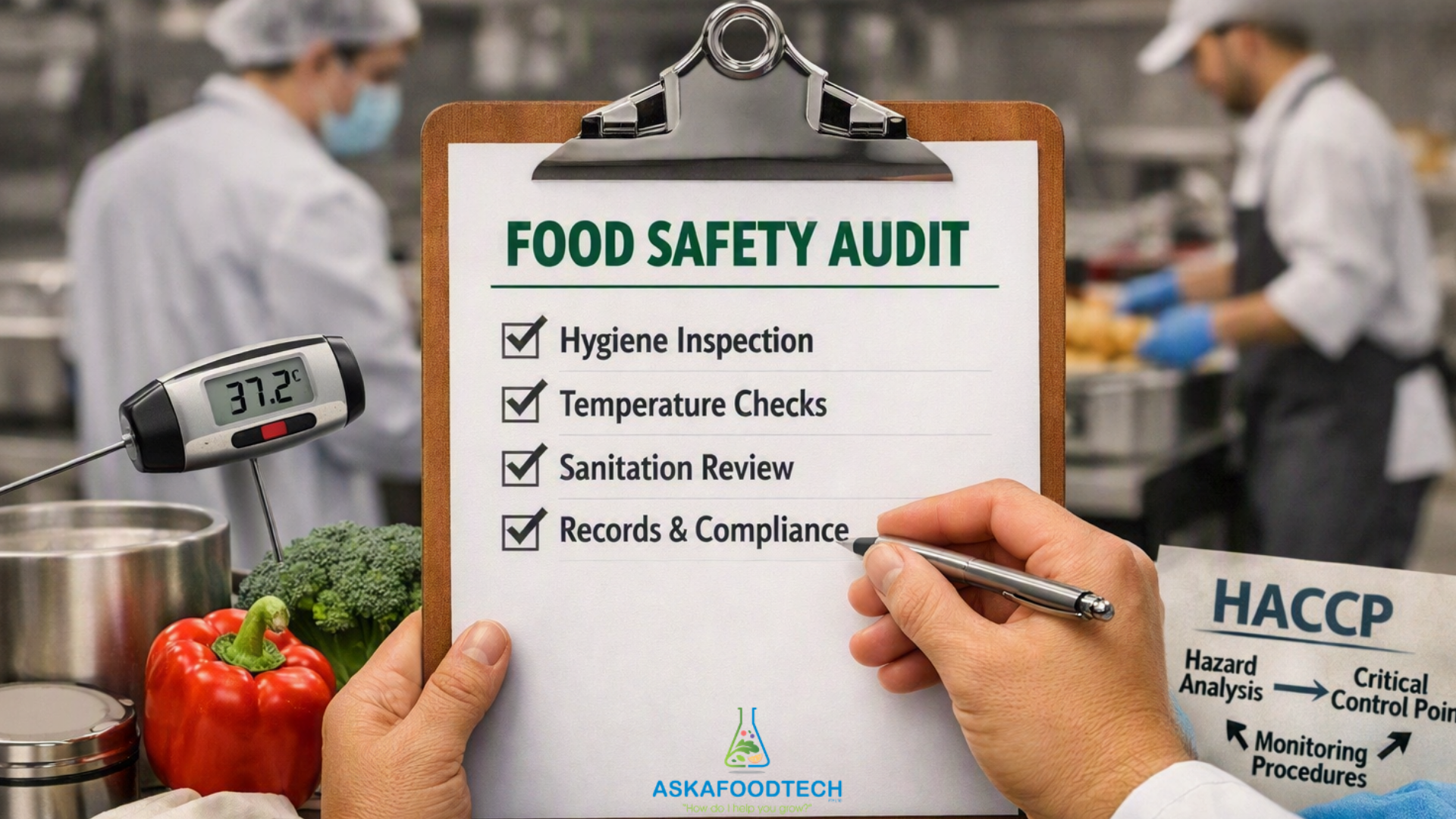
HACCP (Hazard Analysis and Critical Control Points) is the backbone of safe food production, but a one-size-fits-all, off-the-shelf document is often insufficient for a complex, evolving operation.
Ramifications of Non-Adherence (Generic Plans):
- Invisible Risks: Generic plans fail to account for the specific hazards of your unique equipment, new product formulations, process steps, or facility layout. This leaves significant and unmanaged risks in your critical control points (CCPs).
- Legal Vulnerability: In the event of a foodborne illness outbreak, regulators will audit your documentation. If your plan is generic and doesn't accurately reflect your actual process or the hazards encountered, your business may be deemed negligent, leading to severe fines and immediate public health orders.
"Shelf-Life Testing is Complete When the Product Tastes Good at the Expiry Date."
Sensory evaluation (taste, texture, smell) is only one part of shelf-life assessment. True compliance requires microbiological and chemical stability testing to prove the product is safe and compliant for the entirety of its life.
Ramifications of Non-Adherence (Incomplete Shelf-Life Data):
- Unsafe Product in Market: A product can look and taste fine but still contain dangerous levels of pathogens (like Listeria or Salmonella) or toxins. Releasing a product with unproven safety is the fastest route to mass consumer illness and prosecution.
- Loss of Retail Trust: Major retailers demand robust, defensible shelf-life data. Without it, you lose credibility, cannot secure premium placement, and risk costly de-listing should a safety incident occur.
"Our Supplier Sends Us a Certificate of Analysis (CoA), So We Don’t Need to Validate Ingredients."
A CoA is important, but a due diligence defence under the FSANZ standard requires more than just receiving a piece of paper. Your business is ultimately responsible for the safety of its final product.
Ramifications of Non-Adherence (Blind Trust):
- Allergen Cross-Contamination: Relying solely on a supplier's CoA for allergens without establishing clear receiving protocols, verification checks, or having an appropriate supplier approval program exposes your customers to undeclared allergens—the most common cause of Australian product recalls.
- Contaminant Risk: If a supplier's raw material fails to meet safety limits (e.g., heavy metals, pesticides) and you haven't validated their control measures, you are responsible for the contaminated product on Australian shelves.
Strengthen Your Safety, Secure Your Future.
Food safety compliance should be viewed as a strategic investment, not a cost burden. A robust, customised, and fully implemented food safety system minimises risk, opens doors to larger markets, and protects your brand equity.
If you are a brand looking to:
- Review and customise your current HACCP plan.
- Implement a rigorous Supplier Assurance Program.
- Establish a defensible shelf-life testing protocol.
ASKAFOODTECH provides the expert guidance to turn compliance from a concern into a competitive advantage.
Predicted Standards in 2030: We anticipate the future of food safety, particularly under FSANZ, will be defined by greater digitalisation and transparency. By 2030, expect a stronger emphasis on real-time data logging, end-to-end traceability via digital supply chains, and mandatory use of predictive analytics (e.g., AI/IoT) for identifying pathogen risks before they manifest. Proactive, digitally-integrated safety management will transition from a best practice to an absolute requirement.
That forecast is based on continuous regulatory signals and global trends in food technology, rather than a single, publicly released FSANZ document specifying a 2030 mandate.
While we couldn't retrieve an official, final "2030 Digitalisation Roadmap" document via search, the prediction is strongly aligned, with the strategic direction of global and Australian/NZ food safety bodies.
The Foundational Drivers for the 2030 Prediction:
- FSANZ Strategic Priorities: The focus has consistently been on modernising the Food Standards Code to keep pace with innovation, which includes accommodating new technologies.
- Global Regulatory Shifts: Agencies like the US FDA are already implementing the "New Era of Smarter Food Safety," which is entirely focused on digital traceability, predictive analytics, and tech-enabled food safety. Australia/NZ regulatory movements typically track and adapt successful elements of these global shifts.
- Industry Demand: Retailers and consumers demand greater transparency and assurance. Technology like blockchain for traceability, IoT sensors for real-time monitoring, and AI for trendspotting are rapidly moving from novel concepts to mandatory requirements in high-end supply chains.
The prediction is a professional consensus forecast that proactive adoption of real-time data and digital integration is the best way for Australian businesses to stay ahead of the next wave of compliance.
Contact us today
to schedule an audit or discuss your food safety needs.
Drop a HACCP in the chat and we will send you a copy of this.

About the Author:
Stewart Eddie (Bapp Sc Food Science & Technology) is Director and Principal Food Tech at ASKAFOODTECH PTY LTD; a food technology consulting company that inspires, educates, and serves food producers with an ambition to grow and manage risk. Living with a severe food allergy and being a food technologist, Stewart is uniquely placed to help your food manufacturing business with your allergen management planning. If you would like more information on the services that ASKAFOODTECH PTY LTD can provide, please
contact us.